What You Need to Know Before You Decide
Every patient who contacts us has done their research. What they are looking for — beyond the clinical facts — is someone they can trust to be honest about what this treatment involves, what it can achieve, and what it cannot. This page is written to give you exactly that.
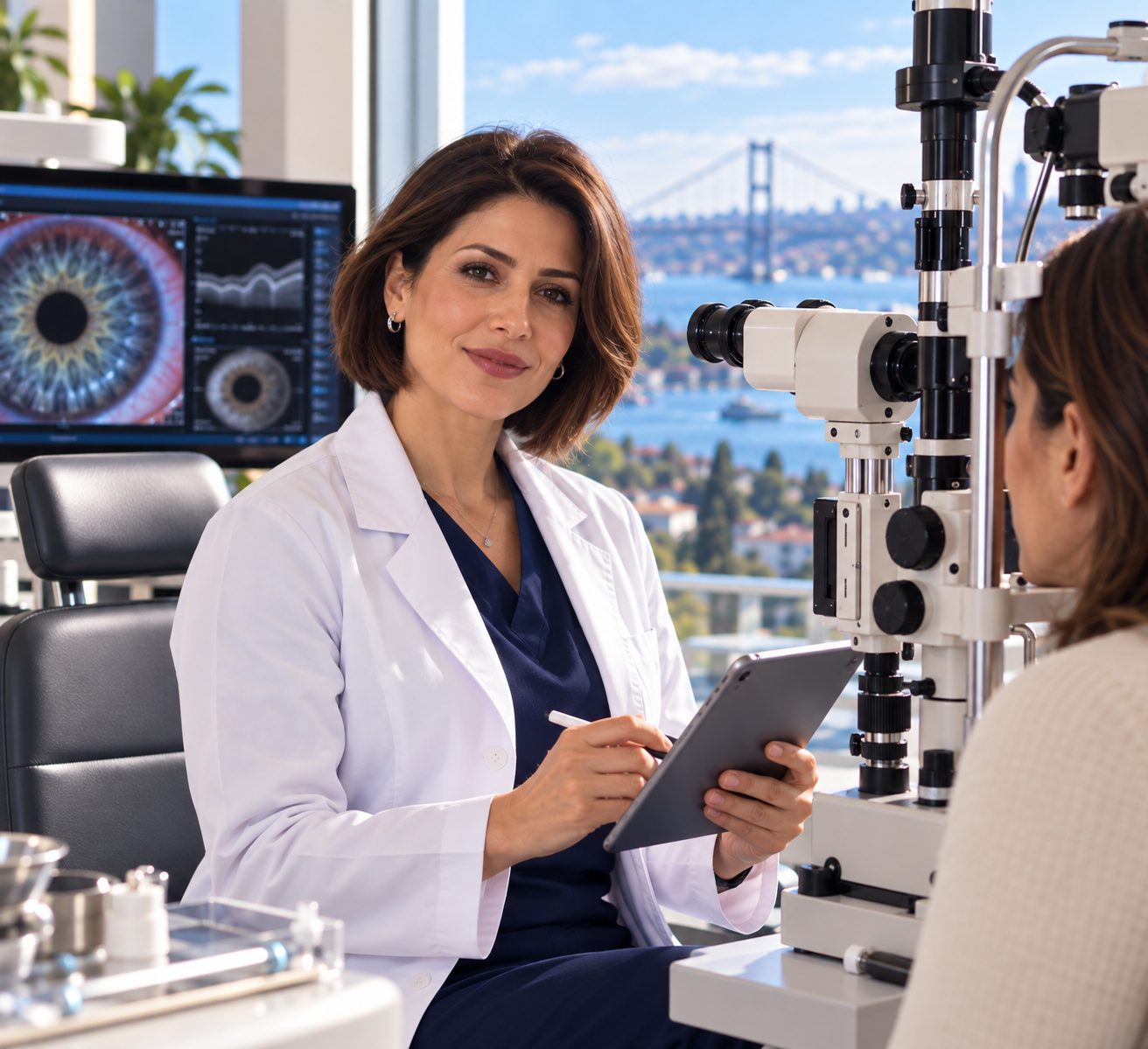
Medical Center Klinik's ophthalmology programme offers the full spectrum of refractive and cataract surgery using the most advanced laser and lens implant technologies available. Our partner ophthalmologists are fellowship-trained in Europe and the United States and treat a wide range of prescriptions and corneal profiles at a JCI-accredited partner facility.
Our refractive surgery portfolio includes LASIK, Femto-LASIK (blade-free all-laser LASIK), LASEK/PRK for patients unsuitable for LASIK, SMILE (Small Incision Lenticule Extraction) — the latest minimal-touch laser refractive technique, implantable collamer lens (ICL/EVO) for patients outside the LASIK prescription range, cataract surgery with premium monofocal and trifocal IOL implants, and presbyopia correction using multifocal or extended depth-of-focus lenses.
Every refractive surgery patient undergoes a comprehensive pre-operative assessment lasting 2–3 hours, covering corneal topography, pachymetry, pupillometry, wavefront analysis, and intraocular pressure measurement. The outcome of this assessment determines which procedure — if any — is appropriate for the individual patient's eye parameters.
Who This Treatment Is — and Is Not — For
Our medical team will give you an honest assessment during your free consultation. We do not recommend treatment that is not clinically appropriate — ever. Here is the general candidacy picture for this procedure.
LASIK and Femto-LASIK are suitable for adults aged 21 and over with a stable prescription for at least 12 months and adequate corneal thickness. Prescriptions within the range of -10.00 to +4.00 dioptres with up to 5 dioptres of astigmatism are typically treatable. Patients with thin corneas, irregular corneal topography, or extreme prescriptions may be better suited to LASEK, SMILE, or ICL implantation.
ICL (Implantable Collamer Lens) is the preferred option for patients with high myopia (above -8.00), thin corneas, or dry eye conditions that would increase the risk of corneal laser procedures. Cataract surgery with premium IOLs is indicated when cataracts are reducing visual quality, regardless of refractive error.
What Happens, and When
From your first message to your final follow-up, every step is managed by your dedicated coordinator. You will never be passed between departments, left without an answer, or surprised by something you were not told to expect. Here is exactly what the process looks like.
Pre-operative assessment (2–3 hours)
corneal topography, pachymetry, pupillometry, wavefront analysis, and biometry; results determine procedure eligibility
Procedure selection and informed consent
your ophthalmologist explains the recommended procedure, alternative options, and realistic outcomes in detail
Drops applied to dilate pupils and numb the eye surface; no injections required
Laser procedure or lens implant surgery performed
LASIK/SMILE typically takes 5–10 minutes per eye; lens implant surgery 15–20 minutes per eye
Immediate post-procedure assessment
visual acuity checked before the patient leaves the procedure room
Rest in hotel for remainder of the day
protective eye shields worn overnight as directed
24-hour follow-up check
vision stability confirmed and any adjustment to post-operative medication made
Discharge with post-operative eye drops, protective eyewear, and written activity restrictions; remote follow-up at 1 week and 1 month
What to Expect After Treatment
Recovery is not something that happens to you — it is something you and your medical team manage together. Our aftercare programme continues long after you leave Istanbul, with scheduled follow-up consultations, direct access to your clinical team, and full documentation for your GP at home.
LASIK and SMILE patients typically experience significantly improved vision within hours of their procedure. Mild blurring, light sensitivity, and a sensation of grittiness is normal for the first 12–24 hours. Vision stabilises over 24–72 hours. Patients should plan to avoid driving on the day of surgery and the following day.
Screen use should be minimised for 48 hours. Swimming and contact sport should be avoided for 4 weeks. Eye make-up should not be worn for 2 weeks. The vast majority of LASIK and SMILE patients achieve 20/20 or better vision by their 24-hour follow-up check. Final prescription stability is confirmed at the 1-month review.
Everything in Your Package — No Hidden Costs
Every item below is confirmed in writing before you commit. There are no surprise charges, no optional extras added at the last moment, and no administrative fees. The price we quote is the price you pay.
How Much Does This Cost?
We provide a personalised cost breakdown after your free consultation — once we have reviewed your specific case, medical history, and treatment goals. There is no commitment required to receive a quote, and no pressure to proceed.
International patients typically pay significantly less than equivalent treatment in the UK, Germany, or the United States — with no compromise on clinical quality, materials, or aftercare standards.
Request Your Free Quote →Answers from Our Patient Coordinators
These are the questions our international patient team answers every day. If yours is not listed here, reach out directly — we respond within 24 hours, without obligation.
Am I a suitable candidate for LASIK?
Suitability is determined by the pre-operative assessment, not by your prescription alone. Factors including corneal thickness, topography, and pupil size all influence the decision. Our ophthalmologist will determine the most appropriate procedure — or advise if surgery is not recommended — based on a full objective assessment, not commercial incentive.
Is LASIK permanent?
LASIK creates permanent structural changes to the cornea. For the vast majority of patients, the vision correction achieved is stable for life. However, age-related changes to the lens of the eye (presbyopia, cataracts) are a natural process unrelated to LASIK and may affect vision in later life independently of the refractive correction.
What is the difference between LASIK and SMILE?
LASIK uses a laser to create a corneal flap, which is lifted to allow laser reshaping of the cornea beneath. SMILE is a flapless procedure in which a small lenticule of corneal tissue is extracted through a tiny keyhole incision. SMILE involves no flap creation and may be preferable for patients with dry eye, contact sports, or occupational risk of eye trauma.
What if my vision regresses after surgery?
Prescription regression is uncommon following modern laser refractive surgery, occurring in a small percentage of patients — typically those with high prescriptions. If regression is identified at follow-up, enhancement surgery is discussed and, where clinically appropriate, performed at a reduced or waived facility fee.
Ready to Take the First Step?
Your free consultation is a conversation — not a commitment. Tell us about your situation, and our medical team will give you an honest assessment of whether this treatment is right for you, what to expect, and what it will cost. We respond within 24 hours — 7 days a week.